Outdoor exercise can be a fantastic way to stay active. Walking, jogging, running, cycling and hiking all provide opportunities to enjoy fresh air, and, a change of scenery.
Exercising outdoors also brings challenges, that you may not encounter indoors, including uneven surfaces, changing weather conditions, heat, cold, traffic, poor visibility and, depending on the activity, an increased risk of falls.
A little preparation can make your outdoor exercise safer, and more enjoyable.
- Choose Suitable Footwear
Wear comfortable footwear that is appropriate for your activity and the terrain. Check your shoes or boots regularly, and replace them when they become excessively worn. Good footwear cannot eliminate the risk of injury, but appropriate footwear can help you to feel more secure on the terrain that you are using. Plus, old unsupportive footwear can cause injuries, and keep you away from fitness for months.
- How to prepare for Snow and Ice
Winter conditions require additional care. Traction devices, such as spikes or crampons, can help to improve your grip, when exercising on icy, snowy, and, slippery surfaces. Gaiters can also be useful in deeper snow, because they help to keep snow out of your boots.
- Dress for the Weather
Choose clothing appropriate for the temperature and weather conditions, when exercising outdoors, is imperative.
In warmer conditions, breathable fabrics can help you stay comfortable. In colder weather, layers allow you to add or remove clothing as your temperature changes.
If you are exercising near roads or in low-light conditions, bright or reflective clothing can help you to be more visible to others.
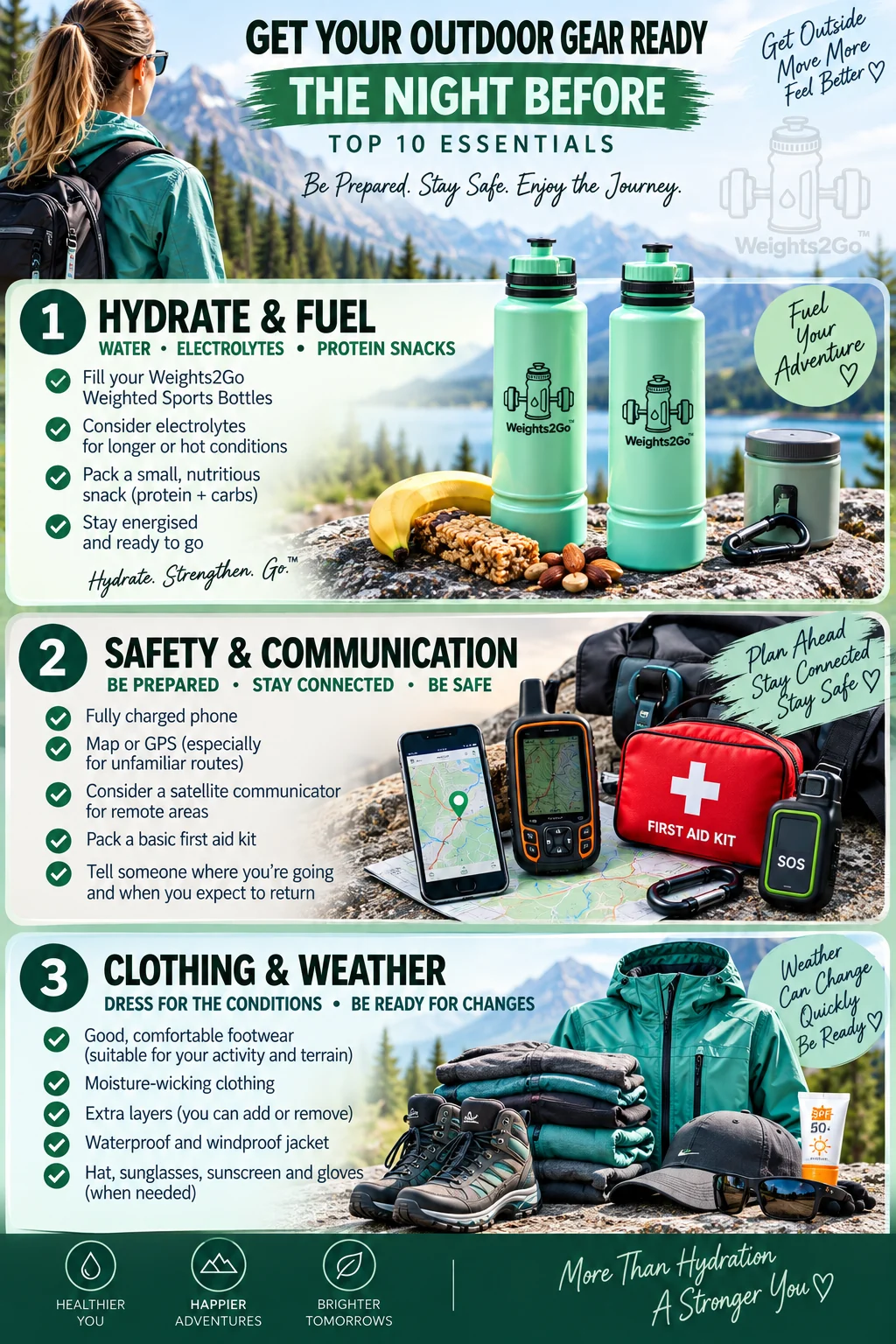
Don’t forget items such as sunscreen, sunglasses, a hat, gloves and an extra layer when appropriate. Outdoor weather can change surprisingly quickly, especially so when out in the mountains.
- Plan Your Route
Before setting out, particularly somewhere unfamiliar, consider your route. Know approximately how far you’re going, how long it may take you, and whether there are difficult sections such as steep slopes, loose surfaces or areas where navigation could be challenging.
It’s always a good idea to let someone know where you’re going, and approximately, when you expect to return. Take a fully charged phone with you. Don’t forget to let that person know that you have returned, so that they don’t send out a search party for you, thinking that you’re missing!
- Take Enough Fluid and Fuel
Hydration is important during exercise, particularly during longer sessions and in hot conditions.
However, there is no single amount of fluid that is right for everyone. Sweat rates vary considerably, and sports-medicine guidance recommends avoiding both significant dehydration and excessive fluid intake.
For shorter or less intense activities, water is often sufficient. During longer or more strenuous exercise, particularly in hot conditions, you’ll need to drink more to replenish the water that you lose through sweating (and breathing). Electrolytes, and a suitable snack containing carbohydrates and protein, may be useful also.
This is where Weights2Go fits naturally into an active lifestyle. Our patented Weighted Sports Bottles are designed to let you carry your hydration while adding actual weight, that provides an opportunity to incorporate resistance into exercise, such as walking, hiking, running, and, other outdoor activities.
- Warm Up
Give your body time to prepare before moving into harder exercise.
A warm-up might include gentle movements, gradually increasing the intensity, a short walk or activity-specific movements.
Research suggests that appropriate warm-ups can improve aspects of physical performance, although the effects depend on the activity, and the type of warm-up used.
- Pay Attention to the Terrain
Outdoor surfaces can sometimes be tricky; examples being loose rocks, mud, roots, steep slopes, snow and uneven ground, can all increase the challenge. Slow down when necessary, and pay attention to where you are stepping, rather than becoming distracted by the scenery.
If a section of your route becomes unsafe, there is nothing wrong with stopping, and, turning around to a safer route back.
If you are hiking in areas where bears are present, follow local wildlife-safety guidance and carry appropriate safety equipment. I take my bear spray with me at all times when hiking in the mountains, even in winter, because bears have been known to wake from hibernation.
Have the bear spray somewhere easily accessible, and not, at the bottom of your backpack.
- Check Air Quality and Conditions
Air quality is another consideration, particularly when exercising near busy roads or during periods of wildfire smoke.
As exercise increases breathing rate and depth, exposure to air pollutants during exercise can increase the amount of polluted air entering into the lungs.
Research has found potential respiratory, inflammatory and cardiovascular effects, associated with exercising in areas with higher traffic-related air pollution.
When possible, choose parks, trails or quieter roads away from heavy traffic, and check local air-quality information, before a long or intense outdoor workout.
- Be Careful with Headphones
Music can make exercise more enjoyable, but you still need to be aware of what is happening around you. So, if you wear headphones outdoors, keep the volume low enough to hear vehicles, cyclists, other people, and potential hazards. I wear bone conduction headphones, so that there isn’t anything blocking my ears, and therefore sound.
Maintaining awareness is particularly important when exercising outside.
- Vary Your Activities
If you exercise regularly, consider including some variety, rather than performing exactly the same exercise routine daily, change it up a little.
Different activities can provide different types of movement and loading, but obviously, choosing a different activity doesn’t guarantee injury-prevention.
Training load, technique, previous injuries, strength, recovery, and individual circumstances, can all influence the risk of injury.
- Cool Down
After harder exercise, gradually reduce your intensity, rather than stopping suddenly, this cool-down period can be as little as five minutes. For example, you could finish a run with a gentle walk.
If you enjoy stretching, this can also be a good time to include some relaxed stretches. Stretching is not essential for everyone, so choose what feels appropriate for you.
- Rehydrate After Exercise
After a longer or harder exercise session, particularly in hot conditions, you may need to replace some of the fluid lost through sweating.
Your requirements will depend on factors including exercise duration and intensity, weather conditions, sweat rate, breathing rate, and individual needs.
There is no need to automatically reach for an electrolyte drink after every short workout, but for longer harder durations of exercise, electrolytes can be useful.
There’s more about Electrolytes, right here on our Weights2Go Community page.
- Use Technology If It Motivates You
Fitness watches and apps can help you to track your numbers, such as:
- Distance
- Time
- Pace
- Route
- Exercise duration
- Heart rate
For some people, seeing their progress over time, can be very motivating.
After a number of years hiking in the Spanish Mountains, I reached ‘Hall of Fame’ status, wearing one particular make of heart rate monitor, and watch, with the app on my phone. It really did push me to improve my ‘exercise sessions.’
Remember though, that some measurements, particularly estimated calorie expenditure, are not always precise. The usefulness of the data, also depends on keeping your information up to date, for example, if you lose a lot of weight, remember to change what you weigh within the app.
- Consider a Heart-Rate Monitor
A heart-rate monitor can provide useful information about exercise intensity, and how your heart rate changes, during activity.
However, heart rate is affected by many factors, including temperature, hydration, stress, caffeine, sleep, illness and medication. Devices can also vary in accuracy.
We recommend that you use heart-rate information as one useful tool, rather than relying on it alone.
- Start Gradually
If you’re new to outdoor exercise or returning after a break, you don’t need to do everything at once. Start gradually and allow your body time to adapt.
Build your endurance and training load over time, rather than trying to achieve too much in only a few days.
If you have a medical condition, significant health concerns, take medication, or are unsure whether a particular activity is suitable for you, speak with an appropriately qualified healthcare professional, before starting, restarting, or changing, your exercise programme.
Most importantly – enjoy yourself!
Exercise doesn’t have to feel like a chore. Finding activities that you enjoy can make it easier to stay active, over the long term.
Whether you’re walking around your neighbourhood, hiking a mountain trail, or, heading out for a run, a little preparation can help you to enjoy your time outdoors, while making you more aware of possible safety concerns.
Hydrate. Strengthen. Go.
Disclaimer
The information provided in this article, and on this website, is for general educational and informational purposes only. It is not intended to replace medical advice, diagnosis or treatment from a qualified healthcare professional.
If you experience rapid or unexplained weight loss or weight gain, persistent abdominal swelling or bloating, significant changes in your bowel habits, abdominal pain, or any other symptoms that concern you, please speak to your doctor.
If you are new to exercise, have an existing medical condition, are taking medication, or are unsure whether a particular exercise, diet or weight-loss approach, is suitable for you, speak to your doctor or another appropriately qualified healthcare professional, before starting or changing, your exercise programme.
Research is continually evolving, and individual responses to diet, exercise, sleep and weight loss, can vary considerably.
Research & Further Reading
- Effects of Warming-Up on Physical Performance: A Systematic Review with Meta-Analysis — PubMed record, PMID 19996770. PubMed
View study on PubMed - Cardio-Respiratory Health Effects of Exposure to Traffic-Related Air Pollutants While Exercising Outdoors: A Systematic Review — PubMed record, PMID 31450147. PubMed
View study on PubMed - National Athletic Trainers’ Association Position Statement: Fluid Replacement for the Physically Active — PubMed record, PMID 28985128. PubMed
View study on PubMed - Running Shoes for Preventing Lower Limb Running Injuries in Adults — PubMed record, PMID 35993829. This is a Cochrane systematic review. PubMed
View study on PubMed
· Strategies to Prevent and Manage Running-Related Knee Injuries: A Systematic Review of Randomised Controlled Trials — PubMed record, PMID 36150753. PubMed View study on PubMed