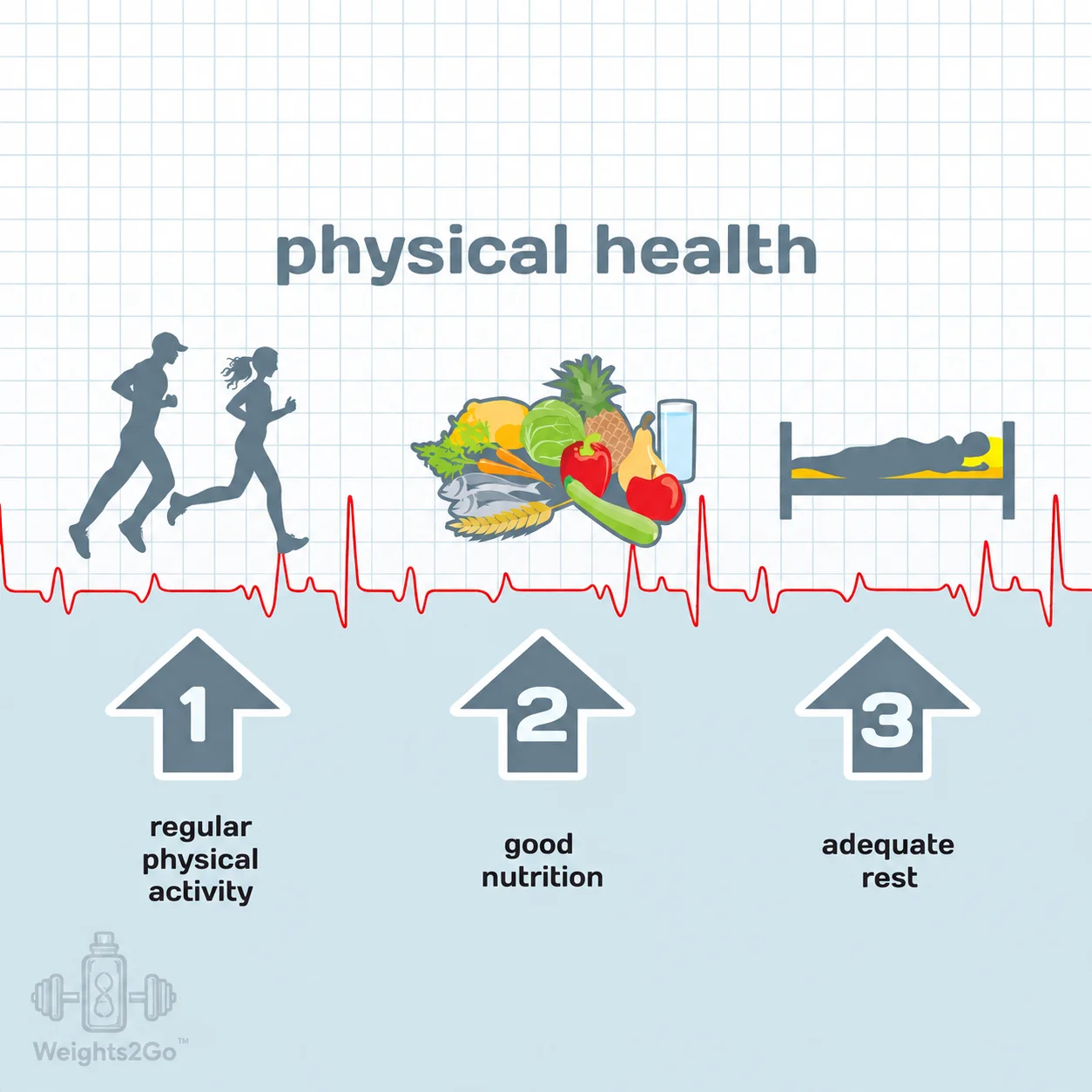
Let’s change this up a little – What does physical health actually mean?
In plain English, physical health is about how well your body functions and how capable you are of doing the things you need — and want — to do.
It isn’t simply about being a certain weight, looking fit or having visible muscles.
Physical health involves many parts of your body, including your:
- ❤️ Heart and cardiovascular system
- 🫁 Lungs and respiratory system
- 💪 Muscles and strength
- 🦴 Bones and joints
- 🧠 Nervous system
- ⚡ Energy and physical stamina
- 🛡️ Ability to cope with illness and recover
Physical health is a broad concept, and physical functioning, is one important part of it.
Why Is Physical Health Important?
Good physical health helps us to move comfortably, perform everyday activities, maintain independence as we get older, and to, participate in the activities that we enjoy.
For example, good physical health can help us to:
🚶 Move More Easily
Walking, climbing stairs, bending, lifting and carrying, these all require physical capacity.
Maintaining strength, mobility and fitness can make everyday activities easier, and help us to remain capable, especially as we age.
💪 Maintain Strength and Muscle Function
Strength becomes particularly important as we get older.
Regular physical activity and resistance exercise can help to maintain muscle strength and physical function, supporting our ability to continue doing everyday tasks for ourselves.
❤️ Support Heart and Lung Health
Regular physical activity can improve cardiovascular fitness, and it help us to develop greater physical capacity.
This doesn’t mean you have to become an athlete.
Even regular, manageable physical activity can form an important part of a healthy lifestyle.
🦴 Support Bones and Movement
Physical activity, including resistance exercise, can support the musculoskeletal system.
Strong muscles, healthy bones and good mobility, all contribute to our ability to move and remain physically capable.
⚡ Improve Physical Capacity
As we become fitter and stronger, everyday activities may require less effort; and being physically capable, can help us to do more, without becoming exhausted so easily.
🧓 Help Maintain Independence
Strength, balance, mobility and physical fitness can all contribute to maintaining independence as we age; for example, being able to get out of a chair, climb stairs, carry shopping or simply walk comfortably, can make a significant difference to everyday life.
😊 Support Overall Wellbeing
Physical activity isn’t only about the body. Research has also associated regular physical activity and exercise, with benefits for areas such as, mood, sleep and mental wellbeing.
Physical Health isn’t about being Perfect
Here at Weights2Go, we believe physical health isn’t about being perfect, being a particular size or looking a certain way.
It’s about keeping your body strong, capable and healthy enough, to help you to enjoy everyday life — today, and as you get older.
The term ‘physical health’ is broader, than physical fitness.
Fitness is one component of physical health, while physical health encompasses the overall functioning and wellbeing of the body.
It also isn’t something we can simply work on for a few weeks and then forget about.
Physical health is an ongoing journey.
When we stop training, some aspects of fitness, strength, conditioning and physiological adaptation, can begin to decline.
That doesn’t mean we need to exercise intensely every day.
It simply means that regular movement and activity, matter.
What does the Research tell Us?
There is a substantial body of research examining physical activity, resistance exercise, strength, mobility, and health.
A large 2023 meta-analysis examined 196 articles covering 94 cohorts and more than 30 million participants, looking at associations between physical activity and cardiovascular disease, cancer and mortality outcomes.
Research involving older adults has also found that resistance training can improve measures such as walking distance, lower-body strength and walking speed, changes that may contribute to greater independence, in everyday activities.
Another 2024 systematic review found that machine-based resistance training improved functional outcomes, and strength, in older adults.
Progressive resistance training, has also been shown to increase muscle strength, and, to a lesser extent, bone mineral density in older adults.
Physical activity, isn’t only associated with physical outcomes. A 2025 umbrella review found suggestive evidence linking physical activity with lower risks of all-cause, cardiovascular and cancer mortality, while sedentary behaviour showed the opposite pattern.
Research into resistance training in older adults has also found improvements in physical functioning, mental health, general health and several quality-of-life measures.
The Takeaway
Good physical health isn’t about looking a certain way – It’s about being capable.
Capable of walking. Capable of lifting and carrying.
Capable of climbing the stairs. Capable of enjoying your favourite activities.
Also, hopefully, capable of continuing to do these things for many years to come.
So, perhaps instead of asking, “Do I look fit?” we should be asking ourselves,
“Is my body capable of doing the things I want it to do?”
Ultimately, physical health is about helping us live our lives to the fullest, today, tomorrow, and, as we grow older.
Hydrate. Strengthen. Go.
Disclaimer
The information provided in this article, and on this website, is for general educational and informational purposes only. It is not intended to replace medical advice, diagnosis or treatment from a qualified healthcare professional.
If you experience rapid or unexplained weight loss or weight gain, persistent abdominal swelling or bloating, significant changes in your bowel habits, abdominal pain, or any other symptoms that concern you, please speak to your doctor.
If you are new to exercise, have an existing medical condition, are taking medication, or are unsure whether a particular exercise, diet or weight-loss approach, is suitable for you, speak to your doctor or another appropriately qualified healthcare professional, before starting or changing, your exercise programme.
Research is continually evolving, and individual responses to diet, exercise, sleep and weight loss, can vary considerably.
Research & Further Reading
- Non-occupational physical activity and risk of cardiovascular disease, cancer and mortality outcomes: a dose-response meta-analysis of large prospective studies — 2023. A large meta-analysis examining physical activity and cardiovascular disease, cancer and mortality outcomes.
- Role of Resistance Training in Mitigating Risk for Mobility Disability in Community-Dwelling Older Adults: A Systematic Review and Meta-analysis — 2022. A review of 24 studies involving 3,656 adults aged 63–83, examining resistance training and mobility-related outcomes.
- Machine-Based Resistance Training Improves Functional Capacity in Older Adults: A Systematic Review and Meta-Analysis — 2024. A systematic review examining resistance training, strength and functional outcomes in older adults.
- Progressive Resistance Training for Concomitant Increases in Muscle Strength and Bone Mineral Density in Older Adults: A Systematic Review and Meta-Analysis — 2022. Examines progressive resistance training, muscle strength and bone mineral density.
- Associations Between Exercise Training, Physical Activity, Sedentary Behaviour and Mortality: An Umbrella Review of Meta-Analyses — 2025. An umbrella review of 48 meta-analyses examining physical activity, sedentary behaviour and mortality outcomes.
A Systematic Review and Meta-Analysis of Resistance Training on Quality of Life, Depression, Muscle Strength, and Functional Exercise Capacity in Older Adults Aged 60 Years or More — 2023. A review of 21 studies involving 1,610 older adults, examining physical functioning, mental health, quality of life and functional capacity.