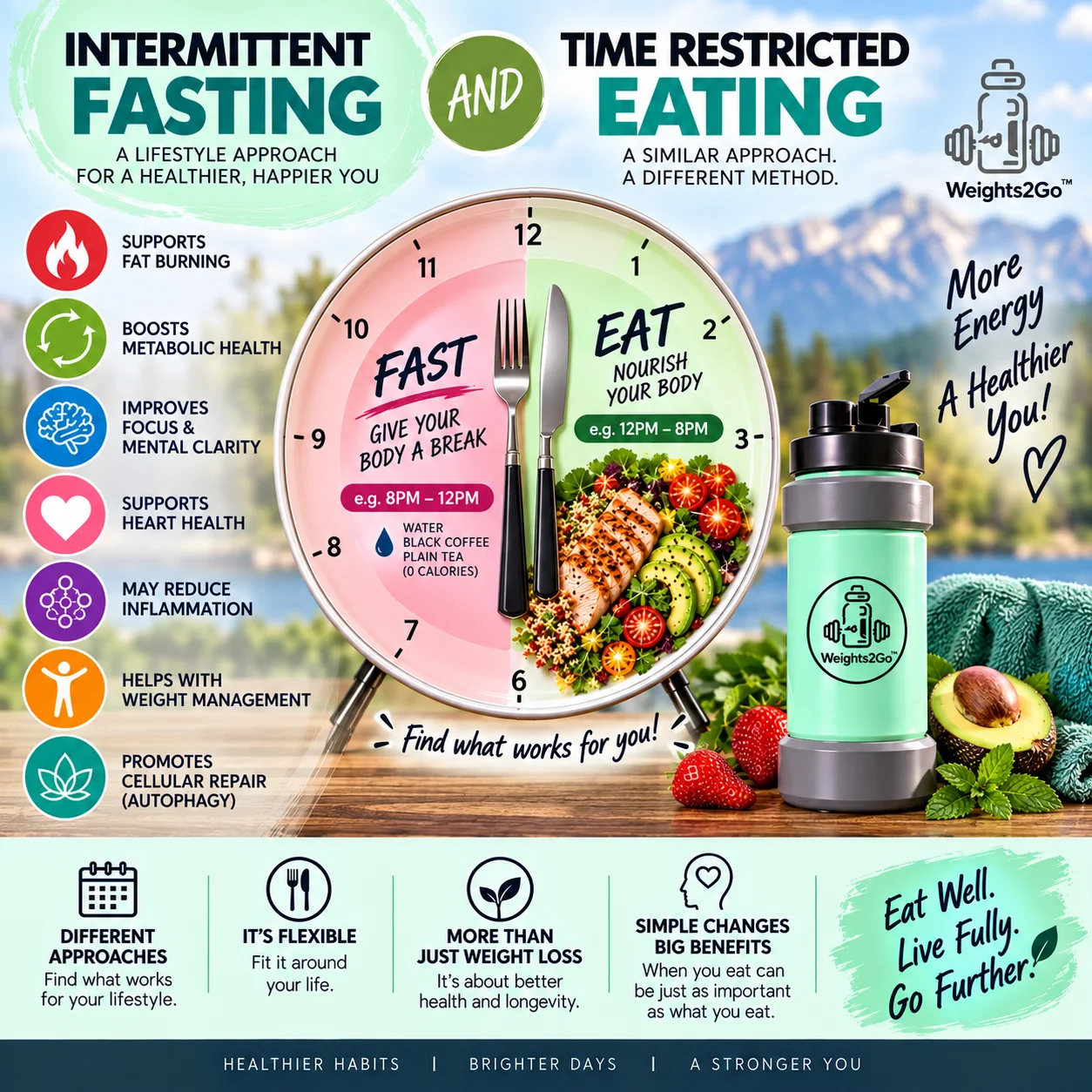
You may have heard of Intermittent Fasting (IF) or Time-Restricted Eating (TRE).
Perhaps you already fast regularly, or maybe you’re wondering what all the fuss is about.
Although the terms are often used interchangeably, IF and TRE are related, but they aren’t exactly the same.
So, what’s the difference?
What Is Intermittent Fasting?
Intermittent Fasting (IF) is an eating pattern that alternates between periods of eating and fasting, ie, not eating. There are several approaches, including alternate-day fasting, the 5:2 approach and daily fasting. When you do eat, it’s called your ‘window.’
I’ve followed intermittent fasting myself for several years.
Time-Restricted Eating (TRE) is a form of IF that focuses specifically on when you eat. You eat within a consistent daily time window.
For example, 16:8 generally means fasting for around 16 hours and eating within an 8-hour window. No, that doesn’t mean eating several bowls of ice cream during your eating window, wouldn’t that be nice?!
Seriously though, fasting isn’t about eating whatever you want, during your eating window. What you eat, matters.
So, in simple terms:
IF = periods of eating and fasting.
TRE = eating within a specific daily time window.
They’re closely related, but TRE is more specifically focused on meal timing.
Does Fasting Help With Weight Loss?
Research suggests that intermittent fasting can be an effective approach to weight management for some people.
A large 2025 systematic review and network meta-analysis examined 99 randomised clinical trials involving 6,582 adults. It found that different intermittent-fasting strategies could reduce body weight and improve some cardiometabolic measures. However, the overall benefits were generally comparable to those achieved through conventional calorie restriction.
Fasting isn’t a magic weight-loss switch. What you eat, how much you eat, and whether you can maintain your eating pattern, over the long term, all matter.
Personally, I’ve never counted calories. For me, it’s just too much bother! But if calorie counting works for someone else, that’s great.
We’re all different.
Different approaches to eating, work differently for people, and sometimes you have to try a few versions, before you find an approach that suits your lifestyle.
What About Time-Restricted Eating?
Research suggests that TRE can produce modest reductions in body weight and fat mass, although results vary between studies and individuals. Interestingly, a 12-month randomised trial compared people following calorie restriction alone, with people following calorie restriction combined with an 8-hour eating window. The addition of the eating window did not produce significantly greater weight loss.
That doesn’t mean TRE doesn’t work. It means that TRE may be a useful eating structure for some people, rather than a magical method, that automatically causes weight loss.
What Happens When We Fast?
When you stop eating, your body gradually changes how it obtains, and uses, energy.
Insulin levels generally fall. As fasting continues, the body increasingly uses stored energy, including fat, as a fuel source. Longer periods without food can also increase ketone production.
Fasting also affects a number of cellular and metabolic pathways.
You may have heard of autophagy, sometimes described as the body’s cellular “recycling” system. Autophagy is a genuine biological process in which cells break down and recycle damaged or unwanted components. Fasting can influence pathways involved in autophagy, but we cannot simply say that fasting for a particular number of hours switches autophagy “on” and guarantees health benefits in humans. The science is much more complicated than that.
Can Fasting Improve Health?
There is promising evidence that intermittent fasting can improve some measures of metabolic health, particularly in people who are overweight, or have metabolic risk factors.
Research has reported improvements in areas including:
- body weight and waist circumference;
- body fat;
- fasting insulin;
- some blood lipid measures; and
- certain markers of metabolic health.
However, the size of these benefits varies considerably between studies and individuals.
There is also considerable interest in whether fasting might influence inflammation, brain health, ageing and longevity. These are fascinating areas of research, but we shouldn’t turn promising scientific findings into guarantees. Evidence for increased lifespan, for example, is much stronger in animal research than it is in humans.
My Own Experience
I’ve followed intermittent fasting for several years. Personally, I find that it works well for me.
I usually find that fasting for around 14–20 hours each day suits me better than longer fasts. I have tried a longer fast and reached almost 30 hours, drinking only water, as part of an online fasting group.
I decided that longer fasting simply wasn’t for me.
And that’s the point:
There isn’t one fasting method that works for everyone.
What works well for one person may be completely unsuitable for another.
I also believe that fasting should fit into your lifestyle, rather than make your life fit around fasting, and feel miserable!
If you’re thinking about trying IF, you don’t have to jump straight into a long fast. I certainly wouldn’t recommend starting that way. When I tried my longer fast, I had already been fasting for around a year. Also, if you’re going to try fasting, speak with your doctor first.
Some Things to Consider
If you decide to try intermittent fasting, some sensible principles include:
Start gradually. Give your body time to adjust.
Eat nutritious food. Make your eating window count by including protein, fibre and nutrient-dense foods.
Stay hydrated.
Don’t use fasting as an excuse to overeat. A fasting period doesn’t cancel out an entire day of highly processed food!
Keep moving. Continue exercising, including resistance training, if it is appropriate for you.
Pay attention to how you feel. Remember your ‘Why.’
I particularly like the phrase: “Delay, but don’t deny.”
If you’re slightly hungry and your planned eating window is approaching, you may be able to wait a little while. You might tell yourself, “If I’m still hungry in 30 minutes, I’ll eat.”
Keep busy and sometimes the hunger pang will pass; but there’s an important difference between mild hunger and feeling unwell.
If you feel dizzy, weak, sick or otherwise not right, listen to your body and eat.
Fasting should never be about ignoring warning signs.
Is Fasting Right for Everyone?
No — and this is really important.
Fasting isn’t appropriate for everyone, and some people should only consider it with professional medical guidance.
If you are pregnant or breastfeeding, have a history of an eating disorder, have diabetes, or take medication that can be affected by changes in food intake, speak with your healthcare professional before trying intermittent fasting.
Also, if fasting makes you feel unwell, it may simply not be the right approach for you.
The Takeaway
Intermittent Fasting and Time-Restricted Eating are closely related approaches, but they aren’t identical.
IF focuses on periods of eating and fasting, while TRE focuses on restricting eating to a daily time window.
For me, IF fits my lifestyle better because, I have more flexibility over the hours I choose each day rather than following a rigid eating window; but this is just my personal preference.
Research suggests that both approaches can be useful for some people, particularly for weight management and certain aspects of metabolic health.
However, fasting isn’t a miracle “diet”.
There is no substitute for nutritious food, sensible portions, regular physical activity, adequate sleep, and a lifestyle, that you can actually maintain.
For me, fasting is simply one tool that fits into my lifestyle.
And that’s really the most important message:
Find what works for you.
You’ve got this! ❤️
Disclaimer
The information provided in this article, and on this website, is for general educational and informational purposes only. It is not intended to replace medical advice, diagnosis or treatment from a qualified healthcare professional.
If you experience rapid or unexplained weight loss or weight gain, persistent abdominal swelling or bloating, significant changes in your bowel habits, abdominal pain, or any other symptoms that concern you, please speak to your doctor.
If you are new to exercise, have an existing medical condition, are taking medication, or are unsure whether a particular exercise, diet or weight-loss approach, is suitable for you, speak to your doctor or another appropriately qualified healthcare professional, before starting or changing, your exercise programme.
Research is continually evolving, and individual responses to diet, exercise, sleep and weight loss, can vary considerably.
Research & Further Reading
- Intermittent fasting strategies and their effects on body weight and other cardiometabolic risk factors — Semnani-Azad et al., 2025. A systematic review and network meta-analysis of 99 randomised trials involving 6,582 adults.
- Calorie Restriction with or without Time-Restricted Eating in Weight Loss — Liu et al., 2022. A 12-month randomised trial comparing calorie restriction alone with calorie restriction combined with an 8-hour eating window.
- Effects of Intermittent Fasting on Health, Aging, and Disease — de Cabo & Mattson, 2019. A widely cited review examining the biological mechanisms and potential health effects of intermittent fasting.
- Intermittent fasting and health outcomes: an umbrella review of systematic reviews and meta-analyses of randomised controlled trials — Moon et al., 2024. An umbrella review examining the broader human evidence surrounding intermittent fasting.
- Metabolic Efficacy of Time-Restricted Eating in Adults — Wang et al., 2022. A systematic review and meta-analysis of randomised controlled trials examining TRE and metabolic outcomes.
Does early time-restricted eating reduce body weight and preserve fat-free mass in adults? — He et al., 2024. A systematic review and meta-analysis examining early TRE, body weight and body composition.